






Wellbeing


Skiddle’s very first Wellbeing Week took place W/C 22nd July and the week was packed with special events, lunchtime walks and a variety of workshops designed to get everyone feeling motivated to improve their wellbeing. The activities that we had planned, hopefully re-energised you and was a perfect opportunity to sample some relaxation and mindful initiatives, here are a few pictures from the activities:Following on from this, to keep the momentum we have been very lucky to secure 2 virtual workshops which are just for Skiddle, please see below dates and the links provide more information on what the workshop covers and information on the coach delivering the session:
- Embracing Difference on Thursday 29th August at 2pm until 3pm
- Uncovering Financial Wellbeing on Monday 23rd September at 2pm until 3pm
The links to book on the above sessions will be communicated via slack shortly
Please note: There are enough places for every employee to join however as these have just been made available for Skiddle employees only, the minimum number of attendees to run the workshop is 20 people , therefore if you are interested please book your place as soon as I share the links
3 tips to get active: The mental benefits of physical activity
As many as 60% of UK adults admit that anxiety impacts their daily lives. According to findings from Vitality, those who engage with the Vitality Programme and who exercise at least three days every week were found to have a 33% lower risk of anxiety and depression compared with less active members. Simultaneously, members who are active are more likely to improve their mental wellbeing over time.
With the benefits of physical activity so well documented, exercise is now being prescribed by GPs for people who suffer from mild to moderate symptoms of mental ill-health. Meanwhile, a recent study found that group running two to three times a week delivers the same mental health boost as a course of antidepressants.
So, with the warmer weather just around the corner, here are 3 simple tips to getting more active:
1. Every little helps
Given the sedentary nature of many workplaces and the fact many staff are now WFH (permanently or on a more flexible basis), making physical activity achievable can be a gamechanger. There’s no need to dedicate hours at a time to exercise. Instead, short, ‘snackable’ bursts – whether that’s a 15-minute HIIT workout first thing or a short jog or walk during the lunch break – can do wonders for our health.
2. Build in activity
Given our busy lifestyles it’s also helpful if physical activity fits into our daily routine. This might entail getting off the bus one stop early or walking to the train station rather than driving. For those working at home, a remote workout or online yoga class could be just the ticket.
3. Everyone is different
What works for one staff member might not work for another. Just do something you enjoy! This could be something as simple as buying a skipping rope or throwing a frisbee in a near-by park. Gyms are also a great place to find new activities to try where there are experts on hand to help you.
Studies have shown that mindfulness can reduce symptoms of depression and anxiety. 27% of Vitality members who use the ‘Headspace app’ (included within your Vitality membership) were found to have greater improvement in their mental wellbeing over time, compared with those who did not use the platform

Neurodiversity in the workplace – Pre-recorded webinar
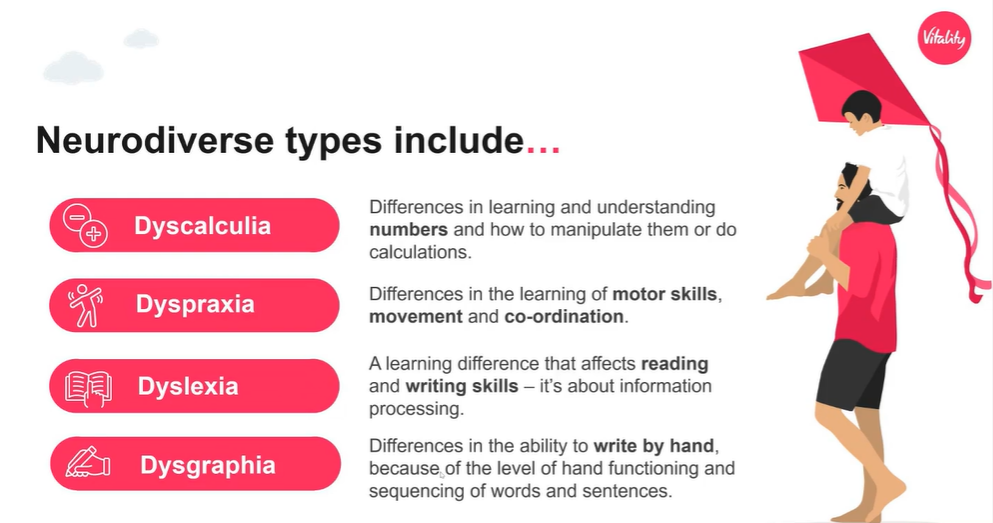
‘Neurodiversity’ is the concept that our brains are all unique, and the way we think varies naturally. It is estimated that 1 in 7 people in the UK are neurodiverse, with diagnosed neurological conditions including (but not limited to) ADHD, Autism and Dyslexia.
Please click on the link to access pre-recorded webinar that Vitality have recently released. In this webinar you’ll learn:
- The definition of neurodiversity and common neurodiverse conditions, including ADHD and Autism
- The barriers and challenges neurodiverse individuals may encounter in the workplace
- The benefits of neurodiversity diversity in the workplace
You have the power to make a positive choice today for your body and mind...
- 🚶 Can you go for a walk during the day?
- 🥗 Can you cook a healthy lunch?
- 🏋️♀️ Can you commit to doing some exercise?
- 💧 Can you drink more water?
Sometimes it can feel like a battle trying to stay fit and healthy – but the benefits and how you feel after are worth fighting for.
Let’s do this together 💙
I hear you’: How to talk to the men in your life about their mental health
Over half (58%) of men think that society expects them to be emotionally strong and not show weakness.
Despite the fact, one in eight men in England are suffering with a mental health issue, but are struggling to address it; and this is only getting worse with the cost-of-living crisis.
It makes suicide is the biggest killer among men under the age of 50 – more so than any other disease or diagnosis. It’s also the leading cause of death in the UK for 10-19 year olds.
Here are some simple ways you can support the men in your life with their mental wellbeing and how you can encourage them to make positive changes for their health:
1. Encourage a good work-life balance
It can be easy to fall into the trap of pulling long nights behind your at-home desk. To encourage a healthy work-life, boundaries need to be set. There needs to be a differentiation between home time and working hours.
It won’t always be perfect and longer hours can’t always be avoided, but ensuring a healthy balance of home life is essential for looking after wellbeing.
2. Support unconditional self-acceptance
The biggest block to good mental health can be how hard we are on ourselves. We shouldn’t let our strive for perfection get in the way of the good.
The internal critic can be very strong with men and is influenced by upbringing and life experiences. If something goes wrong, sometimes men feel like a failure. The danger is they might merge who they are with what they do. And so, it can be incredibly hard to watch someone struggle with their mental health, particularly if it’s someone we love.
One way to encourage a person who is close to you to have more compassion for themselves is to ensure that their feelings are validated. This might involve making your partner or family member feel seen, heard and loved regardless. Validation lets them know there’s nothing fundamentally wrong with them or their experience. Here are some sentence suggestions to help encourage validation:
“What you are saying and feeling are completely understandable”
“I can see your struggle and how much effort you are giving”
It’s also worth noting that the ability to understand that we are unique and special and not the same as everyone else is all part of self-acceptance.
3. Find a new hobby to try out
Getting creative can reduce anxiety and stress and help to lift our mood. And you don’t have to go down to your local craft store to get creative. When we say ‘creative’ mean just mixing things up in a different way. This could be something as simple as a walk around a new park to awaken the senses. Exercise is also a proven way to better our mental health, but it can be difficult to get started.
A good way to help kick-start someone’s new hobby is joining in with them. You could plan to accompany someone on a long walk that they haven’t explored before or visited for a long time.
A project, such as gardening is also a great way to improve mental wellbeing and get exercise in, as it gets us outdoors and gives us a sense of purpose. If they are up to it, attending a gym class together is a great way to build confidence, and it can be as high or low impact as you like.
Or if going outside isn’t an option, a film night and having dinner together (simply spending more time together) may help them feel more comfortable and willing to talk about how they are feeling. Often just being there for someone and doing small things can be really valuable.
As a Vitality member, you could get a discounted membership at Nuffield Health Fitness & Wellbeing Centres, Virgin Active Gyms and Puregyms. Log into Member Zone for the details.
4. Advocate for healthy habits
What we eat, how we sleep and how much we exercise can have a huge bearing on our mental health. Reducing coffee intake and time on digital devices in the evening is one way to improve our mental health.
Thirty minutes of brisk exercise each day [a minimum of three days a week] is also proven to reduce anxiety and depression, and improves memory and neurogenesis.
This all has an impact on the way we sleep and overall wellbeing, which can help us to better cope with stress on a day-to-day basis.
5. Support them in getting help
Compared with women, men are less likely to seek help for mental health difficulties. In fact, women are 69% more likely to use therapy services than men. It’s widely accepted that during difficult times, men are more likely to go in on themselves than ask for help.
Warning signs that a man in your life might be struggling with anxiety, stress or other frustrations include excessive alcohol drinking, eating too much, problems sleeping and being bad-tempered. But it can be difficult to start the conversation with someone that you think might need help.
And so, here are some pointers from mental health charity Mind that can help, not just conversation going, but help them seek out support.
- Look for information that might be helpful
- Help to write down a list of questions that the person you’re supporting wants to ask their doctor
- Help keep a safe place for their paperwork, prescriptions and records
- Go to appointments with them if they want you to
- Ask if you can help with any practical tasks
- Learn more about the problem they are experiencing
It’s important not to let it get to the stage where there is no way out. Talking things with a professional will help relieve anxiety and emotional distress.
Charities, such as Samaritans, are also available 24/7, 365 days a year. This can be a good option if you think someone is struggling but don’t know how to reach out to someone. Or if they find it difficult to talk to someone at home.